One of the first decisions in any website project is the platform. Should you build on WordPress, the content management system behind a large share of the web, or have a developer build a custom website with a framework such as Laravel, React or Next.js? Both are good choices for different situations. This guide compares them honestly.
What we mean by each option
WordPress is an open-source content management system. You get a ready-made admin panel, thousands of themes and plugins, and page builders such as Elementor. According to W3Techs, WordPress is the most widely used CMS in the world.
A custom website is built from code for your specific needs, usually with a backend framework (Laravel, Node.js, Django) and a frontend framework (React, Next.js, Vue). There is no theme or plugin store; every feature is developed for you.
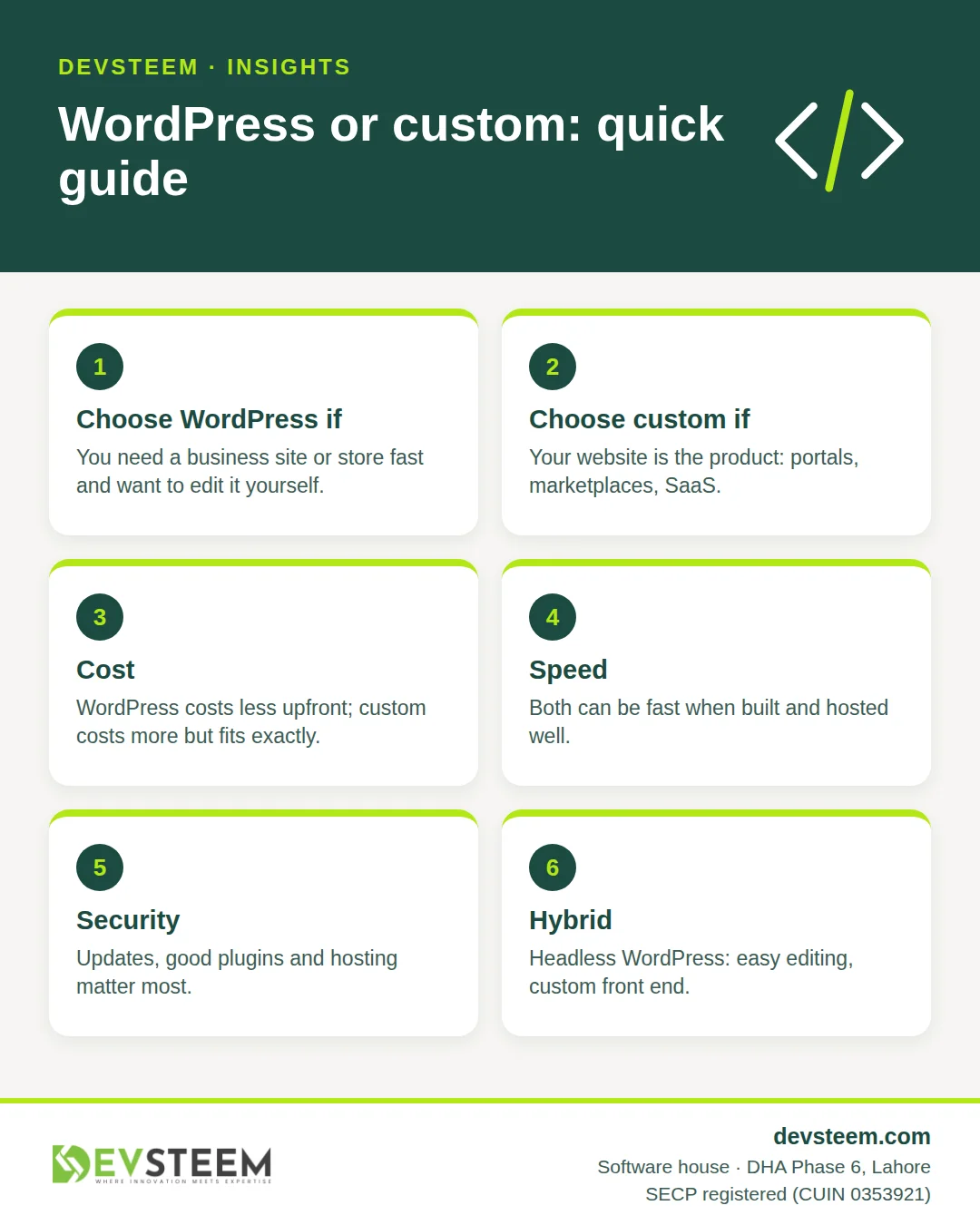
Side-by-side comparison
| Factor | WordPress | Custom website |
|---|---|---|
| Upfront cost | Lower | Higher |
| Time to launch | Days to weeks | Weeks to months |
| Editing content | Easy admin panel | Needs a custom admin or a headless CMS |
| Unique features | Possible with plugins or custom code | Built exactly to spec |
| Performance | Good if well optimised | Excellent if well built |
| Security | Depends on updates and plugin choice | Depends on code quality and hosting |
| Developer availability | Very high in Pakistan and worldwide | Depends on the stack |
| Long-term maintenance | Core, theme and plugin updates | Framework and dependency updates |
When WordPress is the better choice
- You need a business website, blog, portfolio or small online store quickly.
- Your team wants to edit pages and publish posts without a developer.
- Your budget is limited and you want to launch, test and grow.
- You need common features that already exist as trusted plugins: SEO, forms, bookings, WooCommerce.
Most of the clinic, salon, real estate and service-business websites we build start on WordPress, because it gives owners control and keeps costs predictable. See our website packages.
When a custom website is the better choice
- Your website is the product: a marketplace, SaaS dashboard, booking engine or portal with logins and complex rules.
- You need deep integrations with your own systems, ERPs or payment flows (see our API development service).
- You expect high traffic and want full control over performance and infrastructure.
- You need a mobile app and a website sharing the same backend.
Common myths
“WordPress is not secure.” WordPress core is actively maintained. Most hacks come from outdated plugins, weak passwords and cheap hosting. Following the official WordPress hardening guide and keeping everything updated solves most problems.
“Custom is always faster.” A well-built WordPress site with caching, optimised images and a light theme can score well on Core Web Vitals. A badly built custom site can be slow.
“WordPress is only for blogs.” Many large company websites and online stores run on WordPress and WooCommerce.
A hybrid option: headless WordPress
You can use WordPress only as the content admin and build the front end in Next.js or React. This gives editors the familiar WordPress dashboard and developers full control over speed and design. It costs more than standard WordPress but less than building a custom CMS.
How to decide in five questions
- Is the website a marketing site or a software product?
- Who will update the content, and how often?
- What is your budget for the first year, including maintenance?
- Which features already exist as reliable plugins?
- Do you plan an app or integrations later?
If you are still unsure, tell us about your project. Our web development team builds on WordPress, Shopify, Laravel, React and Next.js, so we recommend the platform that fits, not the one we prefer.
FAQ
Can I move from WordPress to a custom site later? Yes. Content can be exported and URLs kept the same with redirects, so you don’t lose search rankings.
Is Shopify better than WordPress for e-commerce? Shopify is simpler to run for pure online stores; WooCommerce on WordPress gives more flexibility and no platform transaction fees on some plans. It depends on your products and team.