An app can be a simple booking tool or a full marketplace with payments, chat and live tracking. That is why quotes for “an app” in Pakistan can range from tens of thousands to millions of rupees. This guide explains what you are paying for, so you can plan a budget and compare quotes fairly.
Typical starting points
| App type | Typical scope | DevSteem starting price |
|---|---|---|
| Starter | One platform (Android or iOS), up to 5 core screens, login, Firebase backend | PKR 75,000 |
| Growing business | Android + iOS (cross-platform), up to 10 screens, admin panel, payments, push notifications | PKR 125,000 |
| Full product | Android, iOS and web, custom backend, advanced admin dashboard, integrations, ASO | PKR 185,000 |
These are starting prices from our app development pricing page. Complex products such as marketplaces or fintech apps are quoted after a discovery session.
What changes the price
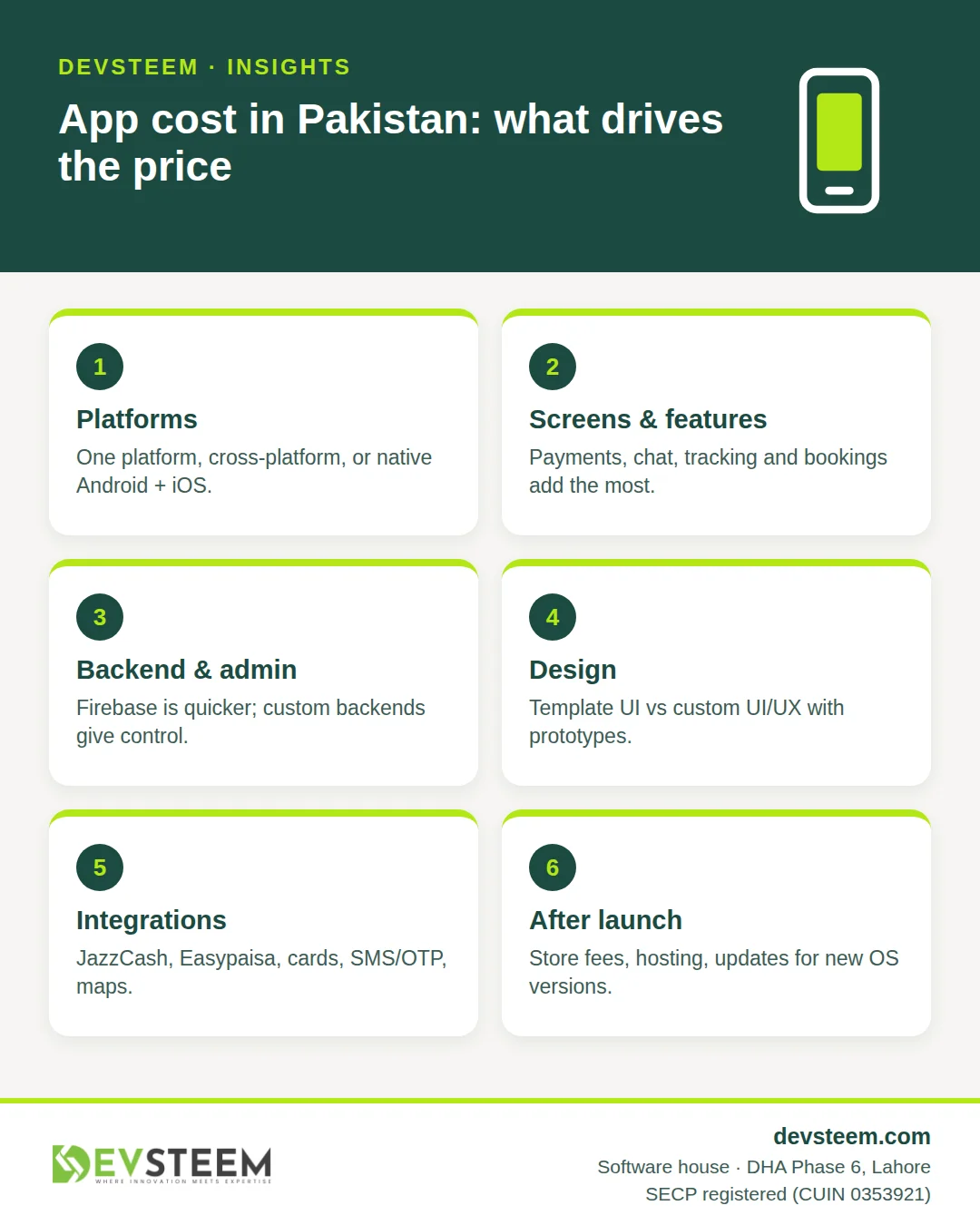
1. Platforms
Building separately for Android and iOS (native) costs more than building once with a cross-platform framework such as Flutter or React Native. Cross-platform suits most business apps; native can be worth it for heavy graphics or deep device features.
2. Number of screens and features
Each screen needs design, development and testing. Features with the biggest impact on cost are:
- payments and wallets
- real-time chat or live location tracking
- bookings with calendars and reminders
- multiple user types (customer, rider, admin)
- offline mode
3. Backend and admin panel
Most apps need a backend to store data and an admin panel to manage users, orders and content. A ready-made backend like Firebase is quicker; a custom backend gives more control and can be cheaper at scale.
4. Design
Template-based UI is faster. Custom UI/UX, with user research and clickable prototypes, costs more but usually improves sign-ups and retention.
5. Integrations
Payment gateways (JazzCash, Easypaisa, cards via Stripe or local banks), SMS/OTP, maps, and existing business systems each add work. See our guide to API integrations for more.
6. Testing and security
Testing on a range of real Android phones (common in Pakistan) and iPhones, plus security checks for logins and payments, is essential. The OWASP Mobile Application Security project is a good reference for what should be checked.
Costs after launch
- Store accounts: Google Play charges a one-time registration fee and Apple charges a yearly fee for the Apple Developer Program (Google Play Console help, Apple Developer Program).
- Hosting and backend: servers, databases and services like Firebase grow with your users.
- Third-party services: SMS, maps and payment gateways charge per use or per transaction.
- Updates: new Android and iOS versions arrive every year, and apps need updates to keep working and stay in the stores.
- Improvements: most successful apps keep adding features after launch.
A common rule is to budget part of the original build cost each year for maintenance. Ask any provider for a written maintenance quote.
How to keep the cost under control
- Start with an MVP. Build the smallest version that solves the main problem, launch, then add features based on real users.
- Write down your features and mark each one “must have” or “nice to have”.
- Choose cross-platform unless you have a clear reason not to.
- Use existing services (Firebase, payment gateways, maps) instead of building from scratch.
- Agree milestones with a demo and payment at each one.
Do you need an app or a website?
If customers use your service occasionally, a fast mobile website may be enough. An app makes sense when people use it often, need notifications, or use device features like the camera or location. Many businesses start with a website and add an app later. Our web development and app development teams can help you decide.
FAQ
How long does it take to build an app? Simple apps usually take 30 to 45 days; multi-feature apps take 60 to 90 days or more.
Will I own the app? You should. Make sure the contract gives you the source code and that the app is published under your own store accounts.
Can you add payments with JazzCash or Easypaisa? Yes, both offer merchant integrations for apps and websites, subject to their approval process.
Ready to plan your app? Get a free quote.